
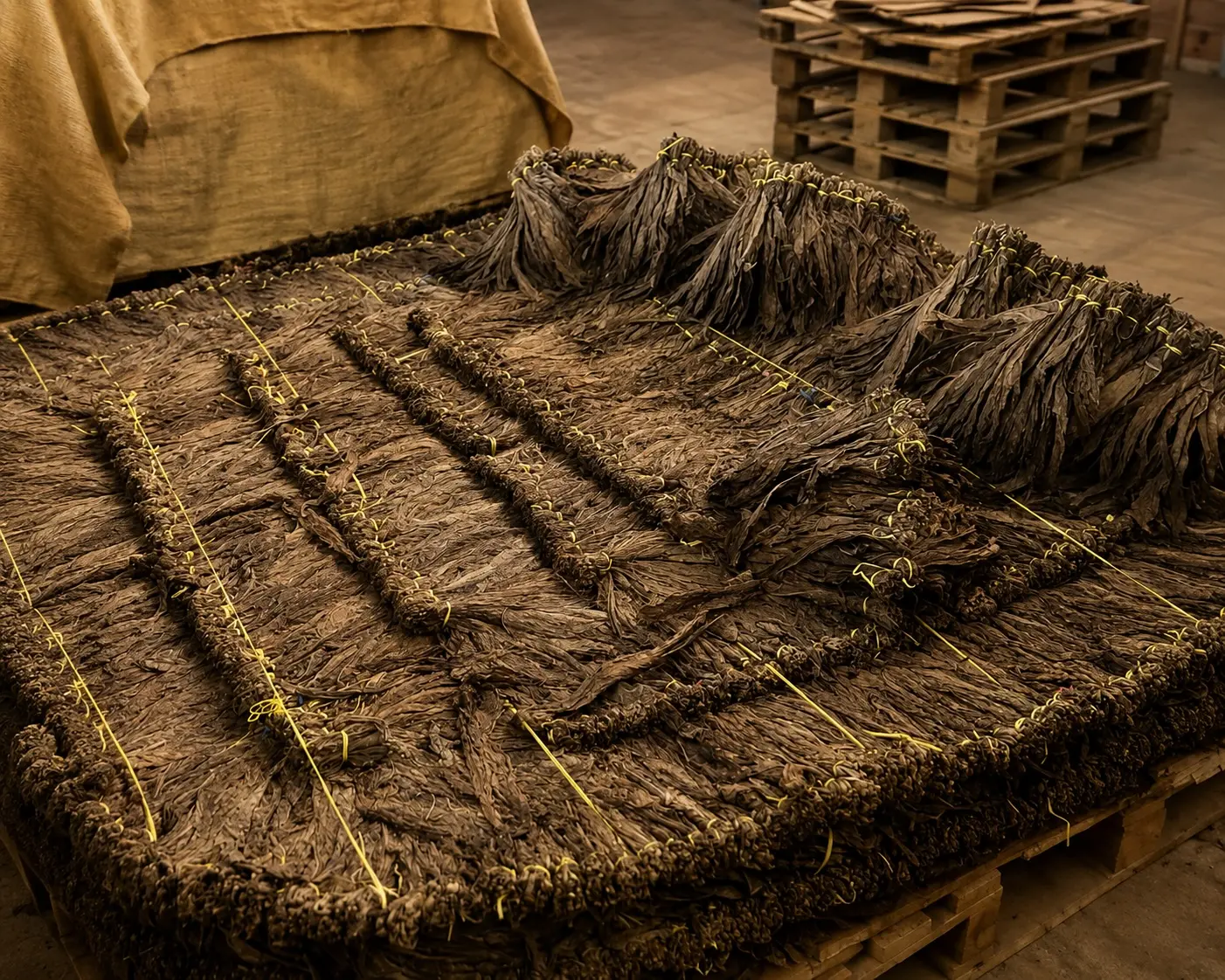
In the factory, tobacco leaves are everywhere. Some have just arrived, others have been here for months.
And some for several years.
A freshly harvested tobacco leaf is not yet something that can be entrusted to a "torcedor".
- It must dry.
- Ferment.
- Rest.
And above all… it must wait.
This notion of time is probably one of the most important things to understand.
Because here, time is not measured in weeks.
Like a fine wine, a good Armagnac or a whisky, it is measured in years.
The pilon
After drying comes the process of fermentation.
The leaves are gathered into large piles known as "pilones".
The phenomenon is natural.
Under the weight of the leaves and the effect of humidity, the temperature gradually rises at the heart of the pile.
Fermentation begins.
But natural does not mean unattended.
A pilon requires constant supervision.
The temperature must be controlled. Humidity monitored. The leaves inspected.
When necessary, the pilon is taken apart.
The leaves are removed, aired, handled and turned.
Those that were at the heart of the pile may be moved towards the outside, and vice versa, so that all the leaves undergo as even a fermentation as possible.
Then the pilon is rebuilt.
And the process begins again.
Again and again.
For months.
It is patient, physical and extremely attentive work. Excessive heat, poorly controlled humidity or uneven fermentation can damage leaves to which a great deal of time has already been devoted.
The objective is certainly not to accelerate the process.
Quite the opposite.
The leaf must be accompanied and given the time it needs to do its work.
Gradually, it transforms.
It loses some of its harshness and bitterness. The ammonia produced during fermentation gradually dissipates.
The aromas evolve.
The leaf that emerges is no longer quite the same one that entered the pilon.
Three years. Sometimes five.
Not all tobacco leaves age in the same way.
Their role in the cigar, their origin, their strength and the way they develop all determine how much time they will need.
For the tobaccos that make up the filler of our Monte-Carlo Club® cigars, we work with leaves aged for an average of three years, with some reaching five years.
Three years during which they occupy space.
Must be controlled.
Handled.
Monitored.
Kept under the right conditions.
And during which, of course, they cannot be sold.
It is an aspect of cigar making that is rarely discussed.
A stock of tobacco is not simply a stock.
It represents years of work and capital patiently waiting in a warehouse.
And behind that waiting are people who continue to monitor and work with the leaves.
In this business, trying to save time often ends up costing time.
A tradition Cuba knows well
This culture of ageing is, of course, not unique to Nicaragua.
In Cuba, it has long been part of the making of great Habanos.
The stronger leaves destined for the filler also undergo long periods of fermentation and ageing.
Some are even set aside for several years for particular productions.
Time adds nothing artificial to the product.
It simply allows what is already there to reveal itself.
That is probably the best way to understand what we seek in our tobaccos.
Then comes the torcedor
After several years, the different leaves can finally be selected to compose the liga.
The blend.
This is when the construction of the cigar truly begins.
For Monte-Carlo Club®, our filler is composed of Nicaraguan Habano tobaccos. The Habano wrapper and binder come from Ecuador.
Each leaf has a role.
Each origin brings something different.
The torcedor can then perform the gesture we immediately associate with cigar making: assembling the leaves and rolling the vitola.
One might think the story ends there.
Not quite.
Another six months
A freshly rolled cigar is not yet a cigar ready to be enjoyed.
The different tobaccos have only just been brought together.
They now need to learn to live together.
Our cigars therefore return to rest for approximately six months.
During this final maturation, the aromas of the different tobaccos begin to meld and the blend gradually finds its balance.
The time required may vary slightly depending on the vitola.
A Churchill and a Robusto do not develop in exactly the same way.
Once again, we must observe and feel…
And wait.
When I light a Monte-Carlo Club® cigar today, I think of the field, the harvest, the pilones, the people who monitor and turn the leaves, and the years of maturation. I think of the torcedor’s hands and those final months of rest.
The hands of the torcedor.
And those final months of rest.
Several years may have passed between the leaf growing in the field and the cigar we hold between our fingers.
We often talk about terroir when we talk about cigars, the seeds, the climate, the craftsmanship, but there is another ingredient, invisible.
Impossible to replace.
Time.
Discover how this blend is expressed across the four vitolas in the Monte-Carlo Club® collection.
That will be our next story.
By Maxime Navarre co-Founder of Monte-Carlo Club® cigars
The leaves are now ready. Discover how they come together in the Monte-Carlo Club® blend.
That will be our next story.