
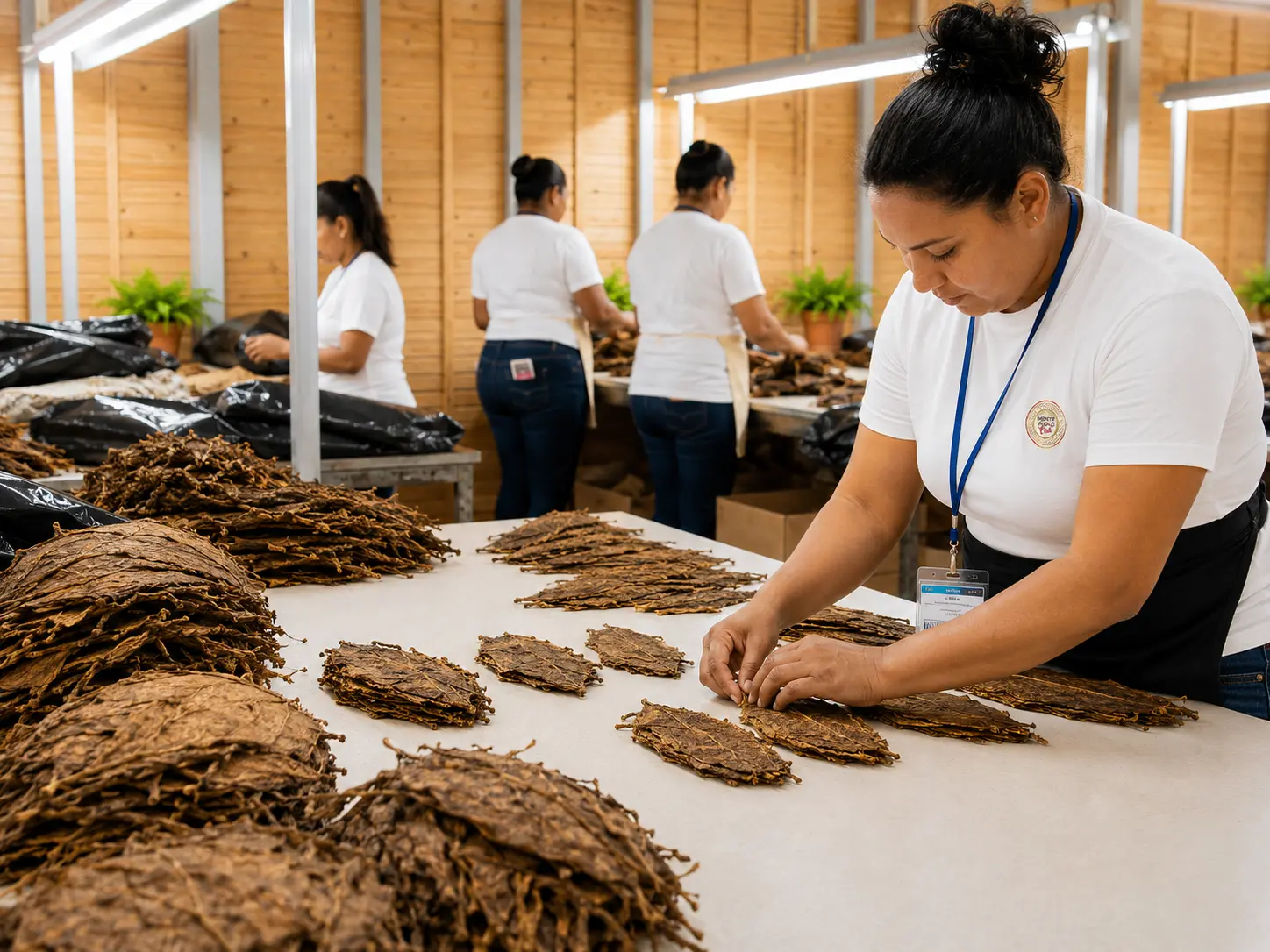
Leaves are now ready. All that remains is to bring them together.
This is where another essential stage in the creation of a cigar begins: the blend.
A leaf, however beautiful it may be, cannot make a cigar on its own. The challenge is to understand how different tobaccos will interact, complement one another and, at times, soften each other.
Much like in winemaking, where blending is not simply a matter of combining good grape varieties, but of finding balance.
At Monte-Carlo Club, we knew quite precisely what we wanted.
A medium-to-full-bodied cigar, with character but without harshness. A slow burn. An even draw. A clearly Nicaraguan identity, but without excessive strength.
Above all, we were looking for a balanced cigar, one that could be enjoyed consistently from beginning to end.
Finding the Right Direction
Creating the blend required several trips to Nicaragua, several days of tasting and a great deal of experimentation.
This is also where the experience of someone like Victor Calvo becomes essential.
We sometimes like to describe him as the cigar equivalent of an oenologist. He knows his land, his leaves, their strength, the way they burn and how they evolve when combined with one another.
Among the tobaccos grown on his plantation is the Criollo used for the filler of our cigars.
But knowing a good leaf is not enough.
You also need to know what to pair it with.
We tasted many different trials, some of them far removed from what we were looking for. We even sampled chocolate- and vanilla-flavoured cigars, where these flavours had been added to the tobacco.
It may seem surprising, but it also illustrates one of the strengths of a manufacturer that understands and controls its raw material: not every leaf has the same purpose.
The finest are reserved for premium blends. Others can be used for products with very different profiles, including flavoured cigars.
The important thing is to understand the potential of each leaf and give it the right role.
A Question of Balance
Several elements work together inside a cigar.
The filler forms its heart. The binder holds everything together. The wrapper completes the cigar.
Yet behind this seemingly simple description lies a multitude of choices.
Every leaf has its own personality.
Some bring strength. Others contribute more roundness, combustion qualities or complexity.
The blender’s task is to ensure that none of them unnecessarily dominates the others.
This is probably where the comparison with wine makes the most sense.
A good blend does not necessarily seek to make every individual component stand out.
It seeks to create a harmonious whole.
The Soil of Nicaragua
As we tasted the different blends, certain sensations began to emerge.
Coffee, in particular.
But also a note that is more difficult to describe, one that some Swiss cigar enthusiasts sometimes refer to as “dusty”.
A sensation of dry, warm earth, almost mineral.
Something deeply connected to the soil, the climate and the origin of the tobacco.
We were particularly drawn to this expression because it seemed to tell something about Nicaragua itself.
In much the same way that a lover of Graves wines may enjoy recognising an expression of the soils of Bordeaux, we wanted our cigar to retain something of its own terroir.
We did not try to create these aromas artificially.
We recognised them gradually through our tastings.
And whenever we found them, we knew we were moving in the right direction.
Choosing the Wrapper
The wrapper also had to meet very specific criteria.
We chose an Ecuador Habano wrapper for two reasons.
The first was visual.
We wanted that slightly marbled, wood-like colour that has become part of the identity of Monte-Carlo Club cigars.
The second reason was more technical.
Ecuadorian wrapper leaves can reach generous dimensions and tend to show fewer pronounced veins.
This allows for a more even wrapper and contributes to a more consistent burn.
Because in a cigar, appearance, flavour and construction are closely connected.
A beautiful leaf must also perform beautifully.
One Blend, Different Experiences
The Monte-Carlo Club blend remains the same across our different vitolas.
And yet a Short Robusto, Robusto, Toro or Churchill will not offer exactly the same experience.
The cigar’s ring gauge, its length and the proportion between wrapper and filler naturally influence the way the blend is perceived.
Its signature remains recognisable.
But the experience changes.
That is also part of what makes cigars so fascinating: the same blend can reveal different nuances depending on the format in which it is expressed.
After months spent drying, fermenting and ageing the leaves, after the trials and tastings, the blend finally gives the cigar its direction.
The leaves have now found their place.
All that remains is to give them shape.
That will be our next story.